What is Tactical Asset Allocation
Tactical Asset Allocation refers to the process of adjusting portfolio exposure over shorter time horizons in response to changing market conditions.
While Strategic Asset Allocation defines the long-term structure of a portfolio, Tactical Asset Allocation operates at a different level. It focuses on temporary deviations from that structure, based on the observation that financial markets do not move in a stable or linear way.
Markets are influenced by a combination of factors, including macroeconomic trends, liquidity conditions, investor positioning and behavioural dynamics. These factors can create phases where certain assets, sectors or regions outperform or underperform significantly over relatively short periods.
Tactical Asset Allocation is designed to engage with these phases.
Rather than maintaining a static allocation at all times, the investor can adjust exposure — increasing or reducing weight in specific areas — in order to respond to current conditions.
This does not replace long-term allocation. It complements it.
A well-structured investment process separates:
long-term positioning, driven by structural factors
short-term positioning, driven by evolving market dynamics
Tactical Asset Allocation sits in the second category.
Why Tactical Allocation exists
The need for Tactical Asset Allocation comes from a fundamental characteristic of financial markets:
market efficiency is not constant.
At times, markets behave in a relatively stable and predictable way. At other times, they become dominated by:
momentum
macro shocks
liquidity cycles
behavioural overreactions
During these phases, asset prices can diverge significantly from long-term equilibrium paths.
A purely strategic approach may fail to capture these dynamics.
For example:
a momentum-driven equity rally may persist longer than expected
certain sectors may outperform due to macro drivers (e.g. energy, rates, inflation)
positioning imbalances may lead to sharp reversals
Tactical Asset Allocation allows the investor to respond to these developments without abandoning the underlying portfolio structure.
The difference between Strategic and Tactical Allocation
Understanding the distinction between Strategic and Tactical Allocation is essential.
Strategic Asset Allocation is concerned with efficiency over the long term. It defines how capital should be distributed across asset classes to achieve a desired risk-return profile.
Tactical Asset Allocation, on the other hand, is concerned with timing and positioning.
It answers a different question:
Given current market conditions, should exposure be temporarily adjusted?
This adjustment can take several forms:
overweighting a specific asset class
reducing exposure to certain sectors
increasing or decreasing risk
focusing on specific regions or themes
The key point is that these changes are temporary and conditional.
They are not structural decisions, but responses to observed market behaviour.
Approaches to Tactical Asset Allocation
There is no single way to implement Tactical Asset Allocation. Different approaches exist, depending on the framework used by the investor.
However, most tactical approaches can be grouped into a few broad categories.
Momentum-based approaches
Momentum strategies are based on the observation that assets which have performed well tend to continue performing well over certain time horizons.
These strategies identify trends and allocate capital to assets that show strong relative or absolute performance.
Momentum is one of the most widely studied and applied factors in financial markets.
Macro-driven approaches
Macro-based strategies focus on economic variables such as:
interest rates
inflation
growth expectations
monetary policy
These variables influence asset prices across markets.
A macro-driven tactical approach attempts to position the portfolio in line with dominant economic trends.
Positioning and flow-based approaches
Market positioning — including institutional positioning, flows and sentiment — can create short-term inefficiencies.
For example:
overcrowded trades
extreme positioning
forced liquidations
These conditions can lead to sharp price movements.
Tactical strategies can be designed to identify and respond to these situations.
The risks of Tactical Allocation
While Tactical Asset Allocation offers flexibility, it also introduces additional complexity and risk.
Short-term positioning is inherently more uncertain than long-term allocation.
Risks include:
mistiming market moves
reacting to noise rather than signal
increasing turnover and transaction costs
overexposure to specific factors
Without a structured framework, tactical decisions can become inconsistent and driven by emotion rather than analysis.
This is why Tactical Asset Allocation should not be approached as discretionary speculation, but as a disciplined and structured process.
What problem Tactical Asset Allocation solves
The core problem Tactical Asset Allocation addresses is the inability of static portfolios to adapt to changing conditions.
A purely strategic portfolio may be efficient in theory, but in practice it can experience periods where:
it underperforms significantly
it fails to capture strong trends
it remains exposed to unfavourable market dynamics
At the same time, an unstructured attempt to react to markets often leads to:
overtrading
inconsistent decisions
poor risk control
Tactical Asset Allocation provides a middle ground.
It allows the investor to engage with short-term opportunities while maintaining a coherent framework.
Tactical Asset Allocation in BTi
Within BTi, Tactical Asset Allocation is implemented through a set of pre-built strategies designed to analyse market behaviour in a structured way.
These strategies are not presented as isolated signals.
They are complete frameworks that allow the user to observe how specific approaches behave over time.
The platform includes multiple strategy types, including:
equity momentum strategies
long-only tactical approaches
regional strategies such as Asia-Pacific
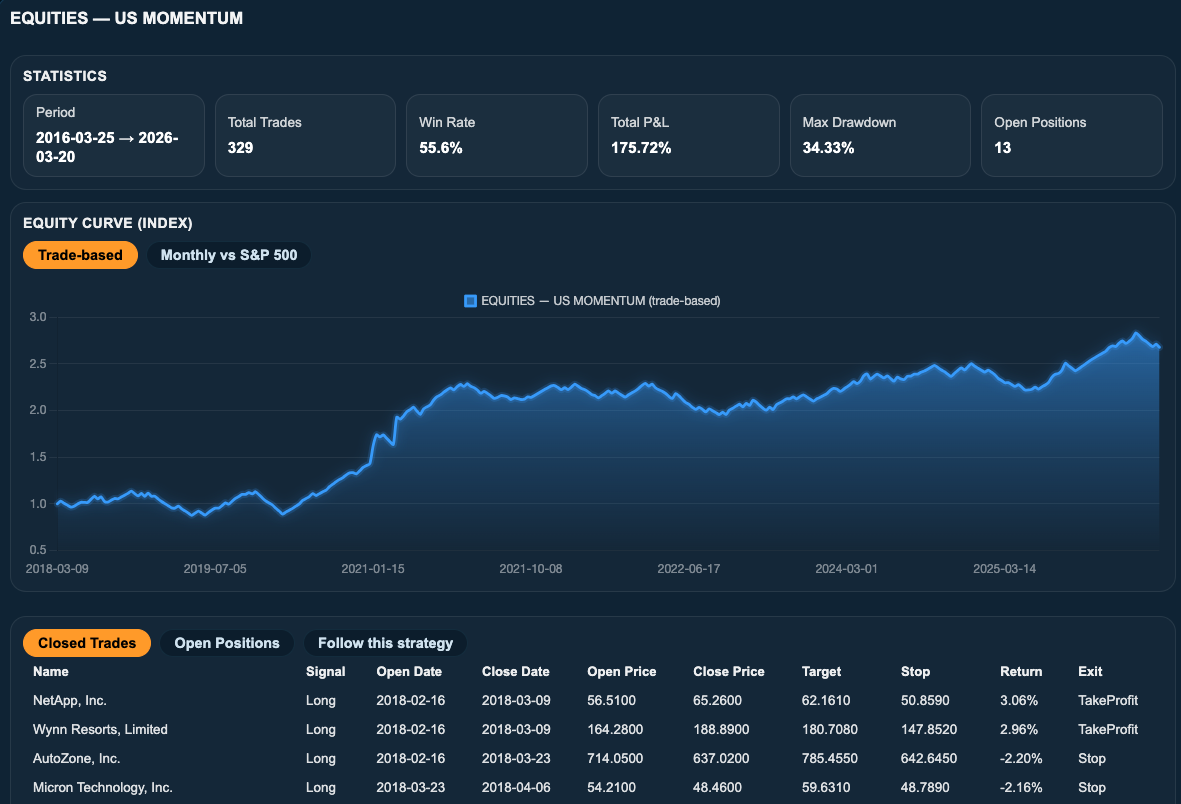
Each strategy is presented through a detailed analytical interface.
From historical behaviour to current positioning
Each strategy in BTi is supported by a full historical track record.
This includes:
number of trades
win rate
total return
maximum drawdown
number of open positions
This information allows the investor to evaluate the consistency and risk profile of the strategy.
The equity curve provides a visual representation of how performance evolves over time, highlighting both growth phases and drawdowns.
In addition to historical data, the platform also displays:
current open positions
recent signals
This connects past behaviour with present conditions.
The investor is not analysing a theoretical model, but a strategy that is actively generating outputs.
How to use Tactical strategies in BTi
Tactical strategies in BTi are designed as decision-support tools.
They are not automated execution systems, and they are not intended to be followed mechanically.
The typical workflow is structured as follows.
The user selects a strategy and reviews its statistical profile to understand its historical characteristics.
The equity curve is then analysed to evaluate how performance evolves across different market environments.
Current positioning is reviewed to understand how the strategy is currently exposed.
At this point, the strategy can be used in different ways:
as a reference framework for short-term positioning
as a source of ideas to be evaluated independently
as a tool to adjust exposure within a broader portfolio
The key element is interpretation.
The strategies provide structure. The decision remains with the investor.
Regulatory positioning
BTi does not provide investment advice, recommendations or personalised portfolio guidance.
The Tactical Asset Allocation module is designed exclusively as an analytical and informational tool.
The strategies presented within the platform:
are based on predefined methodologies
are not tailored to individual users
do not take into account personal financial circumstances
They are provided for the purpose of:
analysing market behaviour
understanding systematic approaches
supporting independent decision-making
Any use of the information remains the sole responsibility of the user.
This positioning is designed to ensure alignment with applicable regulatory frameworks, including FCA, ESMA and Consob.
Tactical Asset Allocation is not about predicting markets.
It is about understanding how markets behave in different phases, and how exposure can be adjusted in a structured way.
Within BTi, this concept is implemented through strategies that combine:
historical analysis
current positioning
structured frameworks
Used correctly, Tactical Asset Allocation becomes a complement to Strategic Asset Allocation.
It allows the investor to engage with short-term dynamics while maintaining long-term discipline.