What is the Market Radar
The Market Radar is a systematic scanning engine designed to identify instruments that meet specific, predefined conditions across global markets.
Instead of analysing one instrument at a time, the Radar works in the opposite direction:
it scans the entire market continuously and highlights where relevant conditions are currently present.
These conditions can include:
technical structure
relative performance
positioning metrics
statistical patterns
custom-defined filters
The result is not a prediction.
It is a filtered universe of opportunities based on objective criteria.
From market complexity to structured selection
Financial markets generate an overwhelming number of potential opportunities at any given time.
The real challenge is not access to information — it is selection.
Most investors operate in a reactive way:
they look at charts
they follow news
they analyse isolated instruments
This approach is inherently limited.
It depends on:
attention
time
subjective interpretation
The Market Radar removes this limitation.
It applies a consistent set of conditions across the entire market and returns only the instruments that satisfy those conditions.
This transforms the process from:
searching → filtering
reacting → structuring
randomness → consistency
How the Radar works in BTi
Inside BTi, the Market Radar is organised by asset class:
equities
ETFs
commodities
indices
FX
alternative assets
Within each asset class, the system groups opportunities based on specific frameworks.
For example:
short-term momentum
strong technical structure
positioning-based setups
relative strength conditions
Each group is defined by clear, measurable rules.
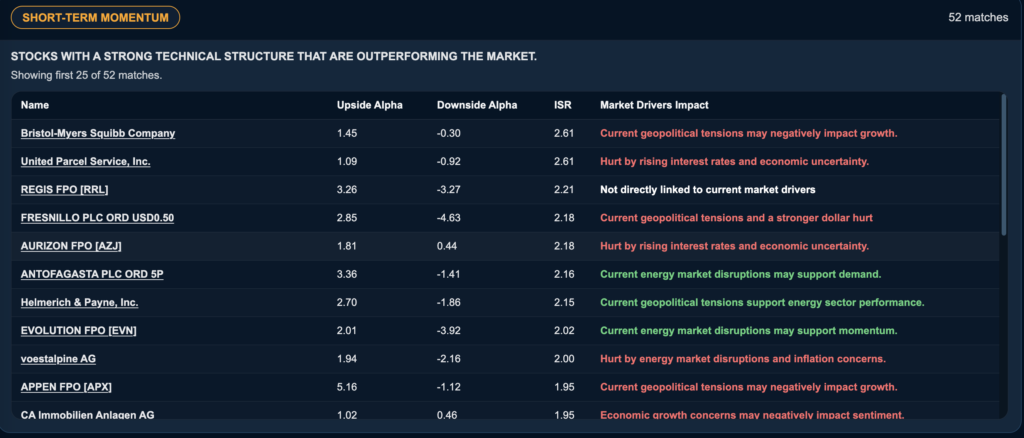
For each group, the platform shows:
the number of matches
the conditions applied
the list of instruments currently meeting those conditions
This creates a structured way to navigate opportunities.
Instead of analysing everything, the investor focuses only on what is already filtered.
The limitation of traditional scanners
At first glance, the Market Radar may appear similar to a traditional screener.
It is not.
A screener tells you what meets a condition.
It does not tell you whether that condition is relevant in the current market environment.
This is a critical limitation.
An instrument can meet all technical conditions and still be:
poorly aligned with macro drivers
exposed to adverse conditions
inconsistent with current market dynamics
This is where most tools stop.
AI Validation: the critical second layer
The key differentiator of BTi is not the Radar itself.
It is what happens after the scan.
Once the Market Radar identifies a set of instruments, BTi applies a second layer:
AI Validation.
This layer evaluates each opportunity in the context of:
current macro environment
dominant market drivers
sector dynamics
cross-asset relationships
The objective is simple:
separate what looks good from what actually makes sense.
From signal to context
Without context, a signal is incomplete.
An instrument may show:
strong momentum
positive technical structure
statistical confirmation
But if the broader environment is not supportive, the probability of success may be lower.
The AI layer addresses this directly.
It takes each instrument identified by the Radar and evaluates it against the current market regime.
For example:
a strong equity signal may be penalised in a risk-off environment
a commodity setup may be reinforced by macro drivers
a positioning-based signal may be flagged as crowded or unstable
This transforms the output from a simple list into a contextualised opportunity set.
Market Drivers: the top-down layer
At the core of the AI Validation system is a top-down approach.
The system continuously processes:
macroeconomic developments
geopolitical events
sector-specific dynamics
cross-market signals
From this, it identifies the dominant market drivers.
These drivers define the current market environment.
Once identified, they are used to evaluate each instrument.
What the AI actually does
The AI does not generate trades.
It evaluates alignment.
For each instrument identified by the Radar, the system assesses whether it is:
aligned with current market drivers
neutral
potentially conflicting with the environment
This is reflected directly in the output.
The result is a qualitative layer on top of quantitative filtering.
Instead of just seeing “what qualifies”, the investor understands:
whether it fits the current market context.
What problem this solves
The combination of Radar + AI solves one of the most critical problems in active investing:
false positives.
A false positive occurs when an instrument meets technical or statistical conditions but fails due to:
macro misalignment
regime change
external drivers
Traditional tools cannot detect this.
BTi addresses it directly.
It reduces noise by:
filtering opportunities (Radar)
validating them (AI)
This two-step process significantly improves the quality of the decision set.
How to use Market Radar with AI in BTi
The workflow is structured and efficient.
The user starts by selecting an asset class and a specific group within the Radar.
The platform returns a list of instruments that meet the defined conditions.
At this stage, the user reviews:
the conditions applied
the instruments identified
the key metrics associated with each one
The next step is critical.
The user evaluates the AI validation layer.
This provides context:
which setups are aligned
which are neutral
which may be exposed to risk
From there, the investor can:
prioritise opportunities
discard weaker setups
focus only on high-quality conditions
The process becomes:
scan → filter → validate → decide
Why this is structurally different
Most platforms stop at data.
Some platforms stop at signals.
BTi introduces a third layer:
contextual validation.
This changes the entire process.
Instead of asking:
“What should I look at?”
The investor asks:
“Among what qualifies, what actually makes sense right now?”
This is a higher-level question.
And it is where real edge is built.
Regulatory positioning
BTi does not provide investment advice or recommendations.
The Market Radar and AI Validation modules are designed as analytical tools.
The outputs:
are based on predefined conditions
are not personalised
do not consider individual financial situations
The AI layer provides contextual analysis, not recommendations.
All decisions remain the responsibility of the user.
The Market Radar identifies opportunities.
The AI Validation explains them.
Together, they create a structured, top-down framework for navigating markets.
Instead of analysing everything, the investor focuses only on:
what qualifies
what is relevant
what is aligned
This is the difference between information and intelligence.