What are Alternative Strategies
Alternative Strategies refer to investment approaches designed to generate returns that are independent from traditional market direction.
Unlike conventional strategies, which typically rely on markets rising over time, alternative strategies focus on relative relationships, inefficiencies and positioning dynamics.
They are built on a different principle:
returns do not need to come from market direction — they can come from structure.
This distinction is fundamental.
Traditional portfolios are often heavily dependent on a single driver: market beta. When equity markets rise, portfolios perform well. When markets decline, performance deteriorates.
Alternative Strategies are designed to reduce this dependency.
They aim to create exposure that is:
less correlated to traditional asset classes
less dependent on market direction
more balanced across different market conditions
This is why they are a central component of advanced portfolio construction.
Why diversification matters
Diversification is one of the most widely used concepts in investing — and one of the most misunderstood.
Many portfolios appear diversified because they contain multiple assets.
In reality, they are often exposed to the same underlying drivers.
For example:
multiple equities driven by the same macro factors
assets reacting similarly to interest rates or liquidity
sectors that move together in risk-on/risk-off environments
This creates hidden concentration risk.
When market conditions change, all positions may move in the same direction, reducing the benefits of diversification.
True diversification is not about the number of positions.
It is about the relationship between them.
Alternative Strategies address this directly.
They introduce exposures that behave differently from traditional assets, improving the overall structure of the portfolio.
The role of Alternative Strategies in a portfolio
In a well-constructed portfolio, Alternative Strategies are not a replacement for traditional investments.
They are a complement.
Their role is to:
reduce portfolio volatility
improve risk-adjusted returns
provide returns in different market environments
balance directional exposure
This is particularly important during periods of market stress.
When traditional assets are highly correlated — for example during sharp equity drawdowns — diversification tends to disappear exactly when it is needed most.
Alternative Strategies can help mitigate this effect.
They provide an additional layer of diversification that is not dependent on long-only market performance.
Types of Alternative Strategies
Alternative Strategies can take many forms, but they are generally based on a few core principles.
Relative value strategies
Relative value strategies focus on the relationship between assets rather than their absolute direction.
They identify situations where one asset is mispriced relative to another and position accordingly.
This approach is less dependent on market direction and more focused on convergence between related instruments.
Arbitrage-based approaches
Arbitrage strategies seek to exploit pricing inefficiencies across markets or instruments.
These inefficiencies may arise due to:
structural differences
temporary dislocations
liquidity imbalances
While pure arbitrage is rare in practice, many strategies operate within a relative value framework that captures similar dynamics.
Commodities and spread strategies
Commodity markets often exhibit structural patterns driven by supply, demand and seasonality.
Spread strategies can be built by analysing relationships between:
different commodities
different maturities
related assets
These strategies introduce diversification because their drivers differ from traditional equity markets.
Positioning-based strategies
Market positioning — such as institutional positioning reflected in data like COT reports — can create opportunities.
Extreme positioning often leads to:
reversals
trend extensions
volatility shifts
Strategies based on positioning aim to capture these dynamics.
FX and cross-market strategies
Foreign exchange markets and cross-asset relationships provide another layer of diversification.
These strategies are often driven by:
macroeconomic factors
relative interest rates
capital flows
They behave differently from equity-driven portfolios.
The risk profile of Alternative Strategies
Alternative Strategies are often perceived as more complex and, in some cases, more risky than traditional investments.
Unlike long-only portfolios, where risk is primarily driven by market direction, Alternative Strategies introduce different sources of risk, including:
model risk
execution risk
breakdown of historical relationships
liquidity constraints
leverage and short exposure
These risks can make alternative strategies less intuitive and more sensitive to structural changes in the market.
However, their role is not to reduce risk in isolation.
Their value emerges at the portfolio level.
Because they are driven by different factors compared to traditional assets, Alternative Strategies can improve the overall balance of a portfolio — even if, taken individually, they may appear more complex or volatile.
This distinction is critical.
They do not eliminate risk.
They redistribute it across different drivers, reducing dependence on a single source of return.
What problem Alternative Strategies solve
The core problem Alternative Strategies address is portfolio fragility.
Most portfolios are structurally fragile because they rely heavily on a single source of return.
This source is usually market direction.
When that driver fails, the entire portfolio is affected.
Alternative Strategies introduce multiple sources of return, reducing dependency on any single factor.
They help transform a portfolio from:
single-driver → multi-driver
directional → more balanced
reactive → more resilient
This is the essence of diversification.
Alternative Strategies in BTi
Within BTi, Alternative Strategies are implemented as a structured set of pre-built strategies designed to provide diversification beyond traditional market exposure.
The platform includes multiple categories, such as:
arbitrage and relative value strategies
commodities-based strategies
positioning-driven strategies (including COT-based approaches)
FX strategies
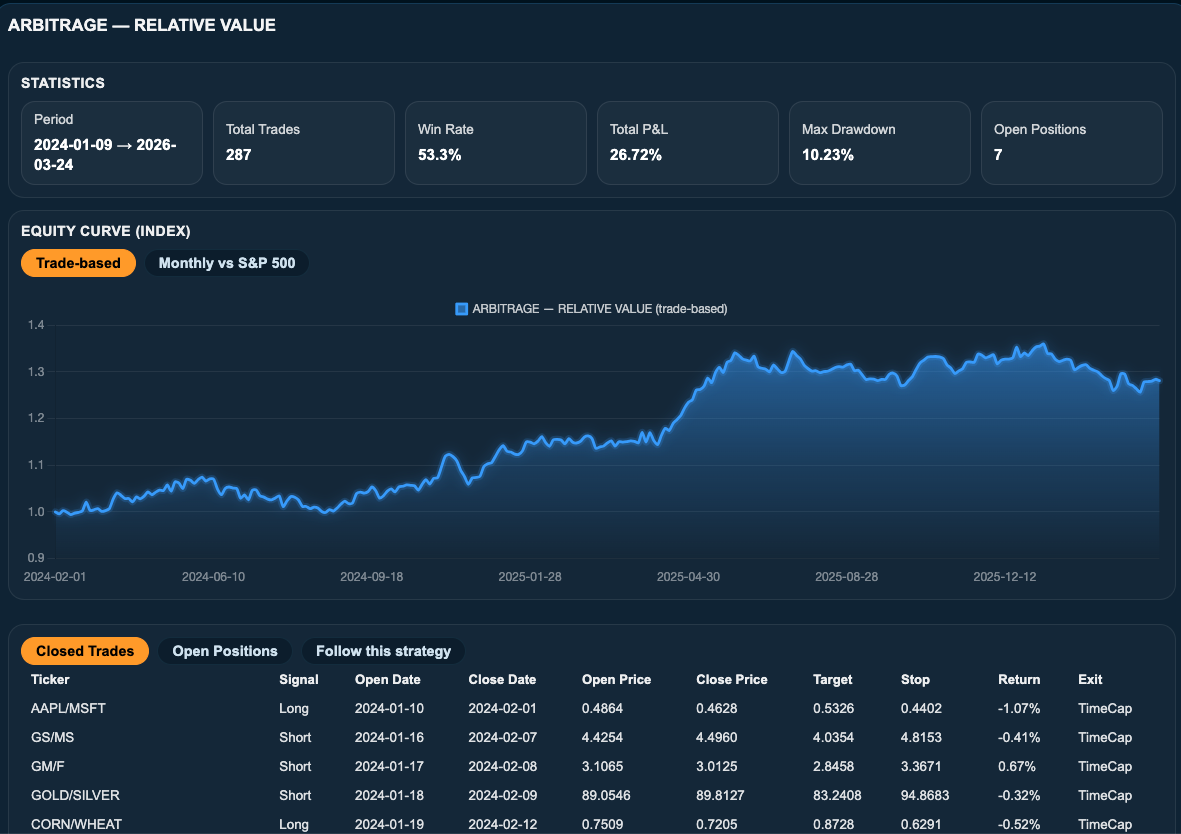
Each strategy is presented through a dedicated analytical interface.
From theory to implementation
Each strategy in BTi is not just described conceptually.
It is implemented and tracked through:
historical performance statistics
number of trades
win rate
total return
maximum drawdown
current open positions
This allows the investor to evaluate how the strategy behaves in practice.
The equity curve shows how performance evolves over time, highlighting both stable periods and phases of volatility.
This is essential because Alternative Strategies are often evaluated incorrectly when viewed only through final return.
Understanding their behaviour over time is key.
How to use Alternative Strategies in BTi
Alternative Strategies in BTi are designed as portfolio components, not standalone systems.
They can be used to:
complement a traditional portfolio
reduce overall volatility
introduce diversification
explore non-directional opportunities
The process is structured.
The user selects a strategy and analyses its statistical profile and equity curve.
The current positioning is then reviewed to understand how the strategy is currently exposed.
From there, the strategy can be used as:
a diversification layer within a broader portfolio
a reference for alternative approaches
a way to reduce dependency on traditional assets
The key is integration.
Alternative Strategies should be evaluated in relation to the rest of the portfolio.
Regulatory positioning
BTi does not provide investment advice or recommendations.
The Alternative Strategies module is designed for analytical and informational purposes only.
The strategies presented:
are based on predefined methodologies
are not tailored to individual users
do not take into account personal financial situations
They are intended to support independent analysis and understanding of market behaviour.
Any decision based on this information remains the responsibility of the user.
Alternative Strategies are not an optional addition.
They are a fundamental component of modern portfolio construction.
They introduce diversification, reduce dependency on market direction and provide access to different sources of return.
Within BTi, these strategies are structured, measurable and integrated into a broader investment framework.
They are not presented as isolated opportunities, but as part of a disciplined approach to portfolio construction.