What is Strategic Asset Allocation
Strategic Asset Allocation is the structural foundation of any long-term investment process. It defines how capital is distributed across asset classes with the objective of achieving the best possible trade-off between return and risk over time.
Unlike short-term trading decisions, which are driven by timing, signals, or market conditions, Strategic Asset Allocation operates at a deeper level. It is not concerned with predicting what will happen next in the market. Instead, it answers a more fundamental question:
How should capital be allocated in order to build a portfolio that is structurally efficient?
This distinction is critical. Many investors focus on selecting strong individual opportunities, yet fail to recognise that performance is ultimately driven by the interaction between positions, not by isolated decisions.
A portfolio is not simply the sum of its components. It is a system.
Each asset contributes not only through its expected return, but also through:
its volatility
its correlation with other assets
its role within the overall structure
Strategic Asset Allocation is the discipline that transforms a collection of ideas into a coherent portfolio.
Within BTi, this process is designed specifically for active investors who want to go beyond generic diversification and instead build portfolios that are quantitatively efficient and structurally robust.
The Efficient Frontier: the core of portfolio efficiency
At the centre of Strategic Asset Allocation lies the concept of the Efficient Frontier.
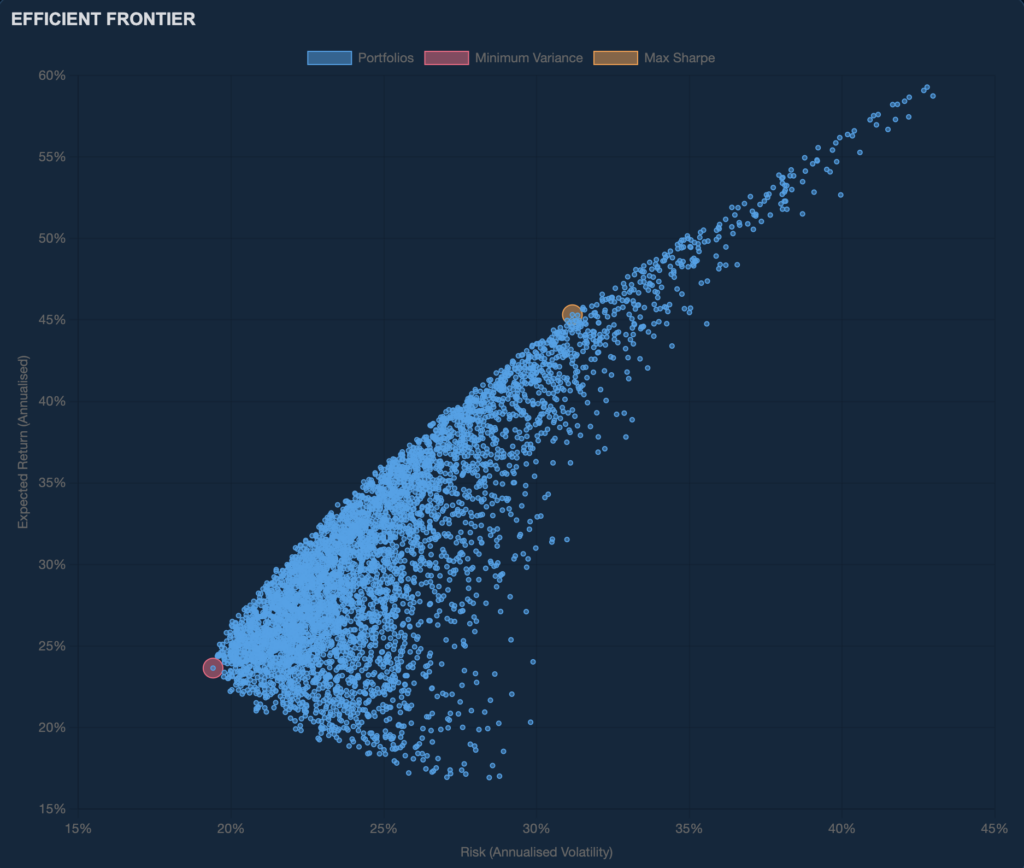
The Efficient Frontier represents the set of portfolios that maximise expected return for each level of risk. Any portfolio that does not lie on this frontier is, by definition, inefficient.
This means that:
it either takes too much risk for the return it generates
or it delivers too little return for the risk it carries
The implication is straightforward but often overlooked:
Most portfolios can be improved without increasing risk — simply by reallocating capital more efficiently.
The Efficient Frontier provides the framework to identify these improvements.
From a technical perspective, the frontier is constructed by analysing all possible combinations of assets and evaluating their:
expected return
volatility
correlation matrix
The optimisation process then identifies the portfolios that dominate all others in terms of risk-adjusted efficiency.
Within BTi, this is not treated as an abstract model.
It becomes a practical tool that allows you to:
visualise the full opportunity set of portfolio configurations
understand where your current portfolio sits
identify superior alternatives immediately
The result is a shift from intuition-based allocation to evidence-based portfolio construction.
From theory to application
Traditional investment tools often present the Efficient Frontier as a static curve derived from simplified assumptions.
BTi takes a different approach.
The Efficient Frontier is dynamically built using real market data, allowing the system to reflect:
current volatility regimes
changing correlations across assets
evolving return profiles
This makes the output actionable.
Instead of relying on theoretical inputs, you are working with a model that adapts to real market conditions — a critical requirement for active investors.
Why most portfolios are inefficient
One of the key insights behind Strategic Asset Allocation is that inefficiency is not the exception — it is the norm.
Even experienced investors often build portfolios that are structurally suboptimal.
This happens for several reasons.
1. Focus on individual ideas instead of portfolio structure
Investors tend to evaluate assets in isolation. A position is considered “good” or “bad” based on its standalone characteristics.
However, what matters in a portfolio context is not just the asset itself, but how it interacts with everything else.
Two strong positions can combine into a weak portfolio if they are highly correlated.
2. Hidden concentration risk
Portfolios often appear diversified on the surface, but are in reality exposed to the same underlying drivers.
For example:
multiple equities driven by the same macro factor
assets reacting similarly to interest rates or liquidity
Without a quantitative framework, this concentration remains invisible.
3. Mispricing of risk
Risk is frequently assessed using simplistic measures, or ignored altogether.
As a result:
portfolios take more risk than intended
volatility is not properly compensated by return
4. Static allocation in a dynamic environment
Markets evolve continuously.
Correlations shift. Volatility regimes change. Return expectations adjust.
A portfolio that was efficient at one point in time can quickly become inefficient if it is not re-evaluated.
Strategic Asset Allocation addresses all of these issues simultaneously by shifting the focus from individual assets to the structure of the portfolio as a whole.
What problem Strategic Asset Allocation solves
At its core, Strategic Asset Allocation solves a structural inefficiency problem.
Most investors operate without a clear framework for determining whether their portfolio is optimal.
They may have:
strong convictions
high-quality assets
good timing on individual trades
Yet still underperform due to poor allocation.
This creates a disconnect between effort and outcome.
Strategic Asset Allocation eliminates this disconnect by introducing a systematic process that:
quantifies the relationship between assets
evaluates the trade-off between risk and return
identifies optimal allocations mathematically
Within BTi, this process is integrated into a broader objective:
building efficient long-term portfolios while enabling active decision-making on top of that structure
The Efficient Frontier becomes the reference point against which all portfolio decisions can be evaluated.
How to use Strategic Asset Allocation in BTi
The Strategic Asset Allocation module in BTi is designed to transform a complex optimisation problem into a clear and repeatable workflow.
It allows you to move from a simple idea set to a fully optimised portfolio in a structured way.
Step 1: Define your investment universe
The process begins by selecting the assets that will form your portfolio universe.
This step is critical because the quality of the output depends on the relevance of the inputs.
You can include:
equities across different regions
ETFs representing sectors or themes
bonds for stability
commodities for diversification
The objective is not to maximise the number of assets, but to construct a coherent and meaningful opportunity set.
Step 2: Generate the Efficient Frontier
Once the universe is defined, BTi computes the full set of possible portfolio combinations.
This is where the system performs the heavy lifting.
Using real data, it evaluates:
expected returns
volatility of each asset
correlation between all assets
From this, it constructs the Efficient Frontier — the set of optimal portfolios.
The visual output immediately reveals:
which portfolios are efficient
which ones should be avoided
Step 3: Identify your optimal portfolio
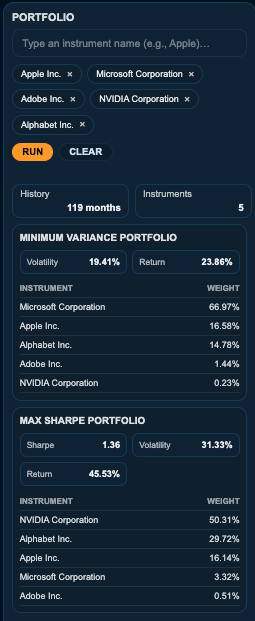
Each point on the Efficient Frontier represents a specific portfolio with a precise allocation across all assets.
This allows you to select the portfolio that best matches your objective.
Depending on your strategy, you may choose:
a higher-return, higher-risk allocation
a lower-risk, more stable portfolio
a balanced configuration
The key difference compared to traditional approaches is that this decision is not arbitrary.
It is grounded in a complete mapping of all efficient possibilities
Step 4: Analyse allocation impact
Once a portfolio is selected, BTi allows you to understand exactly how each asset contributes to the overall structure.
This includes:
how much risk each position adds
how diversification affects volatility
how changes in weights impact efficiency
This level of transparency is essential for maintaining control over the portfolio.
Step 5: Refine and iterate
Strategic Asset Allocation is not a static process.
As markets evolve, the Efficient Frontier changes.
BTi allows you to continuously:
adjust the asset universe
re-run the optimisation
compare different portfolio configurations
This transforms portfolio construction into an adaptive process, rather than a one-time decision.
The role of Strategic Asset Allocation in an active strategy
A common misconception is that Strategic Asset Allocation is only relevant for passive investors.
In reality, it is even more important for active investors.
Why?
Because it defines the baseline structure on top of which all active decisions are made.
Without a solid allocation framework:
short-term trades are applied on an inefficient base
alpha generation becomes inconsistent
risk is harder to control
With Strategic Asset Allocation in place:
the portfolio starts from an efficient position
active decisions are layered on top of a solid structure
performance becomes more consistent over time
This is exactly how BTi is designed to be used.
Strategic Asset Allocation defines the foundation.
Other modules — signals, strategies, AI tools — operate on top of it.
How BTi makes it different
Many platforms offer portfolio optimisation tools.
Very few integrate them into a complete investment workflow.
BTi is designed around a different philosophy.
Strategic Asset Allocation is not an isolated feature. It is part of a system built for active investors.
This means:
The Efficient Frontier is connected to real market data
The optimisation process is fully transparent
The output is directly usable for decision-making
The allocation can be continuously refined
Most importantly, BTi allows you to move seamlessly from:
portfolio construction → optimisation → execution → monitoring
This eliminates the fragmentation that typically exists between analysis and action.
Strategic Asset Allocation is not about complexity. It is about clarity.
It provides a clear answer to a question that every investor faces, often without realising it:
Is my portfolio structured in the most efficient way possible?
The Efficient Frontier turns this question into something measurable.
BTi turns it into something actionable.